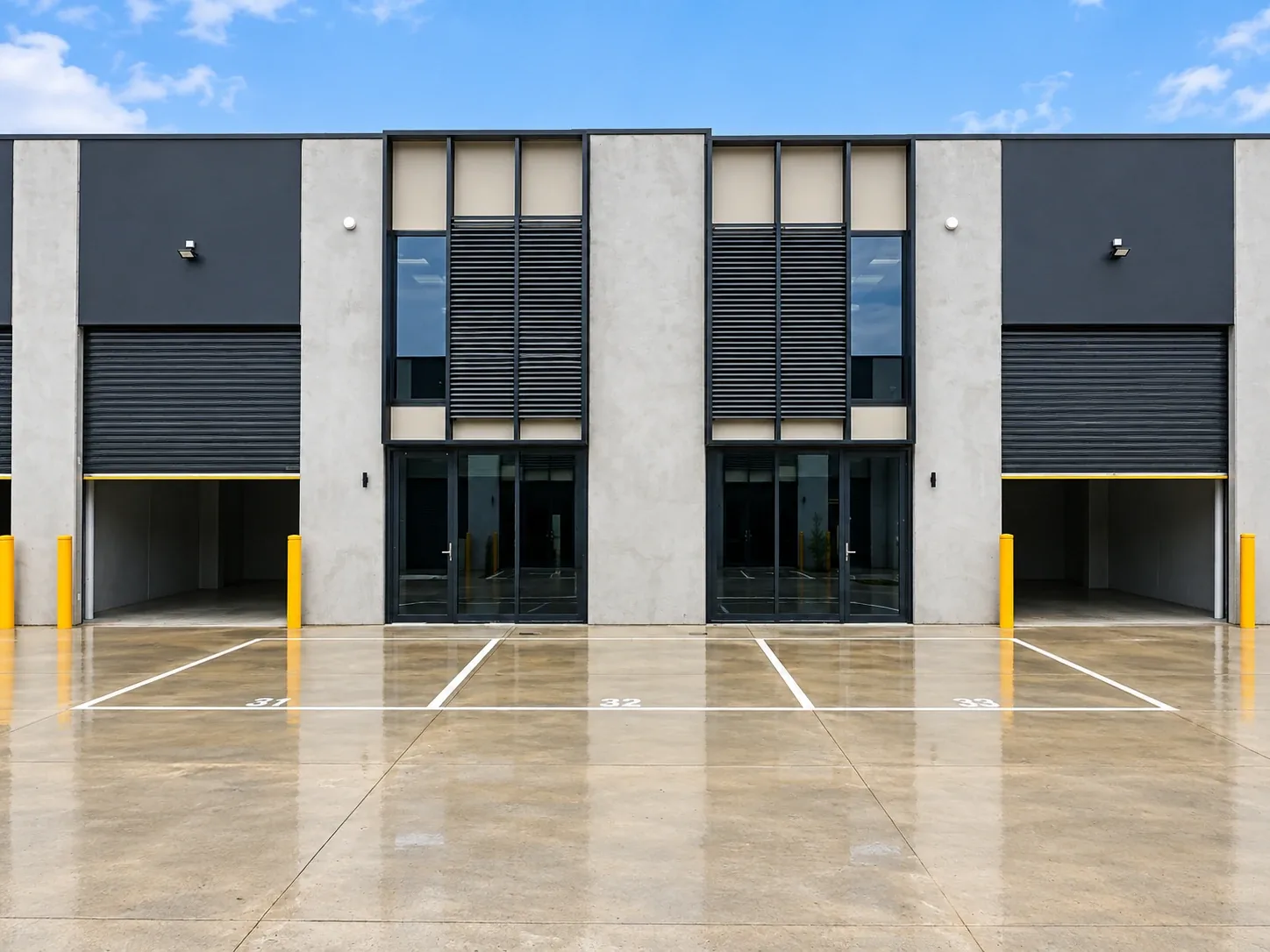
The short answer: in Victoria, the zone on your title decides what you can use a property for and what needs a council permit. Most industrial units in Melbourne's west and Geelong sit in one of five zones: Industrial 1 (IN1Z), Industrial 2 (IN2Z), Industrial 3 (IN3Z), Commercial 2 (C2Z) or the Urban Growth Zone (UGZ). Warehouses are generally allowed without a permit in IN1Z, IN3Z and C2Z, subject to conditions. Offices need a permit in the industrial zones but not in C2Z.
Quick comparison
Industrial 1 Zone (IN1Z)
Its purpose is "to provide for manufacturing industry, the storage and distribution of goods and associated uses in a manner which does not affect the safety and amenity of local communities" (Clause 33.01). Industry and warehouse uses generally don't need a permit, as long as they meet the conditions in the table of uses, such as distances from homes and limits on dangerous goods. An office needs a permit, and its floor area can't exceed the amount set in the zone's schedule.
Example: 4/10 Fink Street, Williamstown North, an office warehouse we sold, is zoned IN1Z.
Industrial 2 Zone (IN2Z)
IN2Z is for major manufacturing and storage that needs a large separation distance from homes, so it usually covers big industrial areas such as ports. Storage units can sit in it too: AlterSpaces Breakwater in Geelong, where we sold units, is zoned IN2Z.
Industrial 3 Zone (IN3Z)
IN3Z provides "a buffer between the Industrial 1 Zone or Industrial 2 Zone and local communities, which allows for industries and associated uses compatible with the nearby community" (Clause 33.03). It also allows limited retail such as convenience shops. A warehouse generally needs no permit, subject to conditions. Most industry, other than service industry, needs a permit, and so does an office.
Examples: MODE Business Park East, Truganina and Unit 75, 23 Chambers Road, Altona North are zoned IN3Z.
Commercial 2 Zone (C2Z)
Its purpose is "to encourage commercial areas for offices, appropriate manufacturing and industries, bulky goods retailing, other retail uses, and associated business and commercial services" (Clause 34.02). Office, industry, warehouse, trade supplies and restricted retail uses generally need no permit, subject to conditions. Food and drink premises up to 100 m² of leasable floor area also need no permit. That flexibility suits businesses that mix office, showroom and storage.
Examples: the office warehouses at 150 Palmers Road, Truganina and MODE Business Park Corio are zoned C2Z.
Urban Growth Zone (UGZ)
The UGZ manages "the transition of non-urban land into urban land in accordance with a precinct structure plan" (Clause 37.07). Once a precinct structure plan applies, the zone's schedule says which zone's rules apply to each part of the precinct, for example industrial or commercial. So two UGZ properties can have very different rules. Always read the schedule number on the title, such as UGZ1, UGZ2 or UGZ6.
Examples: 211A Infinity Drive, Truganina is UGZ2, 13 Maughan Way, Cranbourne West is UGZ1 and 47A Palladium Circuit, Clyde North is UGZ6.
How to check a property's zoning
1. Search the address on VicPlan, the Victorian Government's planning map. 2. Download the free planning property report. It shows the zone, its schedule and any overlays. 3. Read the zone's table of uses for your use, and any conditions. 4. Check overlays too, such as flooding or heritage, which can add permit requirements. 5. If your use needs a permit, or you're unsure, ask the council's planning department before you sign.
Zoning is one of the biggest drivers of an industrial property's value. Read how zoning affects what your industrial site is worth.
Sources
Victoria Planning Provisions, read 18 November 2026: Clause 33.01 Industrial 1 Zone, Clause 33.03 Industrial 3 Zone, Clause 34.02 Commercial 2 Zone and Clause 37.07 Urban Growth Zone. Tables of uses as amended by VC237 (14 January 2025). This guide is general information, not planning advice. Each council's schedules and overlays can change what applies to a particular property.

Fairmont only sells and leases industrial property across Melbourne's western corridor and Geelong. That focus is deliberate. It means we know the buyers who are active right now and what they are prepared to pay.